LAB & FACILITIES
Simulation → real-time HIL → hardware validation.
The Clean Energy & Smartgrid Lab combines inverter-fed microgrids, EV test benches, battery systems and real-time platforms to prove research in the loop.
Inverter-Fed Microgrid
Advanced Power Systems Laboratory for virtual synchronous generators, renewable integration and grid-forming control.
Supports: Microgrids · Grid-forming · Renewable integration
EV Drive & Battery Benches
Test benches for EV propulsion, battery-management evaluation, fast charging, PV emulation and DC microgrid research.
Supports: EV drives · BMS · Charging · Energy storage
Software & Control Platforms
MATLAB/Simulink, Open-DSS, Python and power-system dynamics and control solvers enable repeatable model-to-hardware studies.
Supports: HIL · Control · Grid analytics · Cyber-physical studies
Advanced RenewableSystems Lab Inverter Setup
Virtual Inertia based Renewables | Real-time Control | AC/DC Microgrids
EV Motor Test Bench Equipment
Axial Flux Induction Motors | PMSMS | Drive Systems | Advanced Controls
Real-Time Hardware-in-the-Loop Simulation
HIL of Various Power System Test beds | IEEE 33-bus, 13-bus | PSCAD Simulations | DigSilent
RESEARCH FACILITIES
Research Facilities & Infrastructure
Advanced experimental, simulation, prototyping and testing environments supporting power electronics, smart grids, renewables, electric vehicles, energy storage and intelligent energy systems.
Explore facilities by research function.
Power Electronics & Drives · Smart Grid & Microgrid · Renewable Energy · EV & EV Charging · Energy Storage & Battery Systems · Power Quality & Grid Monitoring · AI / Intelligent Energy Systems · High-Performance Computing / Simulation · Sustainable Mining & Electrification

Hardware Prototype
Hybrid AC Microgrid with Renewable Sources for V2G and G2V Operation
A DC microgrid with solar PV, wind emulator as a renewable energy source, Battery energy storage system, three phase grid, DC, and AC load for EV charging with V2G and G2V facility.
Research applications
AC microgrid voltage control, advanced converter control (with PV and Wind-PMSM)
Major equipment
Roof top solar PV, wind emulator using DC motor, Battery energy storage system, three phase grid, wavect controller.
Research areas
DC microgrid control, distributed control
Principal investigator
Dr. V L Srinivas
Impact outcomes
1 Journal Published
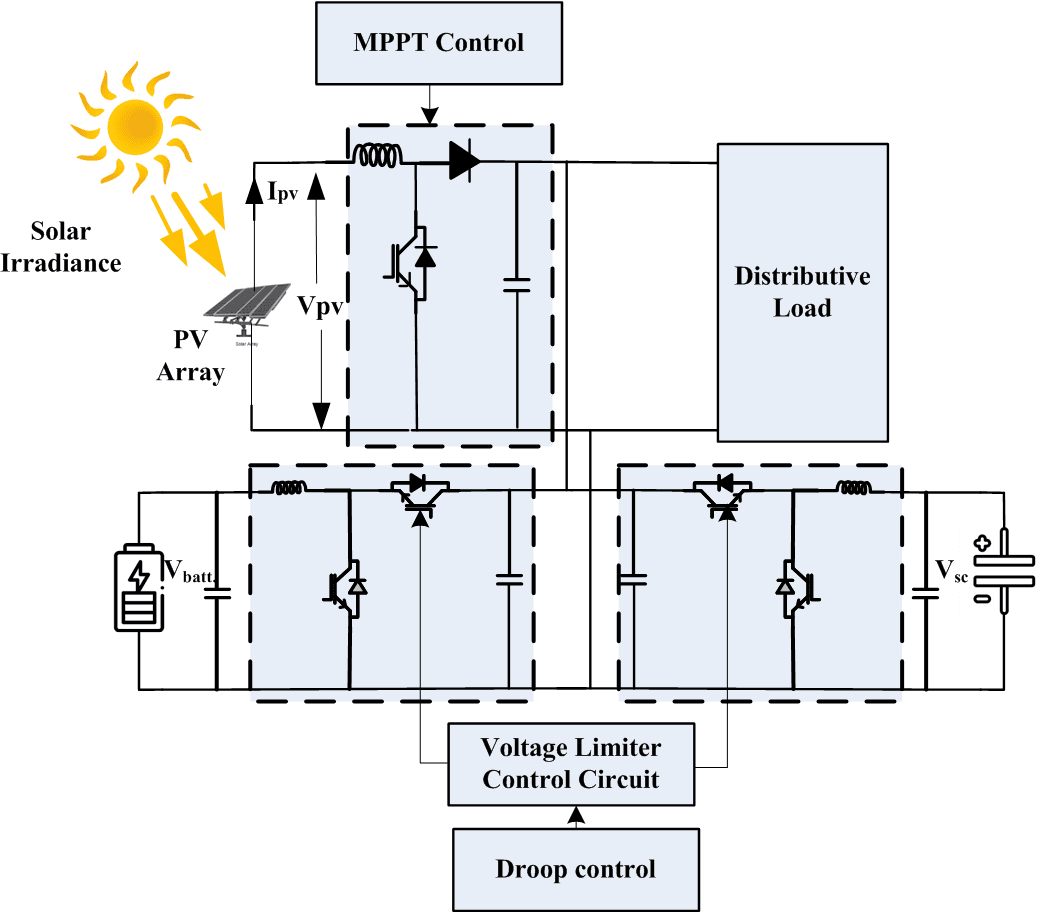
Hardware Prototype
Supercapacitor Assisted DC Microgrid (Multipoint Droop)
A multipoint droop-control-based energy management scheme for a standalone DC microgrid using a battery and supercapacitor to maintain DC bus voltage and improve current sharing during load variations.
Research applications
DC microgrid voltage regulation, energy management, supercapacitor-based transient support, battery current reduction, current sharing, multipoint droop control
Major equipment
110-V DC microgrid with PV source, battery and supercapacitor energy storage, bidirectional DC-DC converters, distributed loads, MPPT-based PV boost converter
Research areas
DC microgrids, energy storage systems, supercapacitors, battery-supercapacitor hybrid energy storage, droop control, multipoint droop control, voltage regulation, current sharing, energy management
Principal investigator
Dr. V L Srinivas
Impact outcomes
1 Journal Published
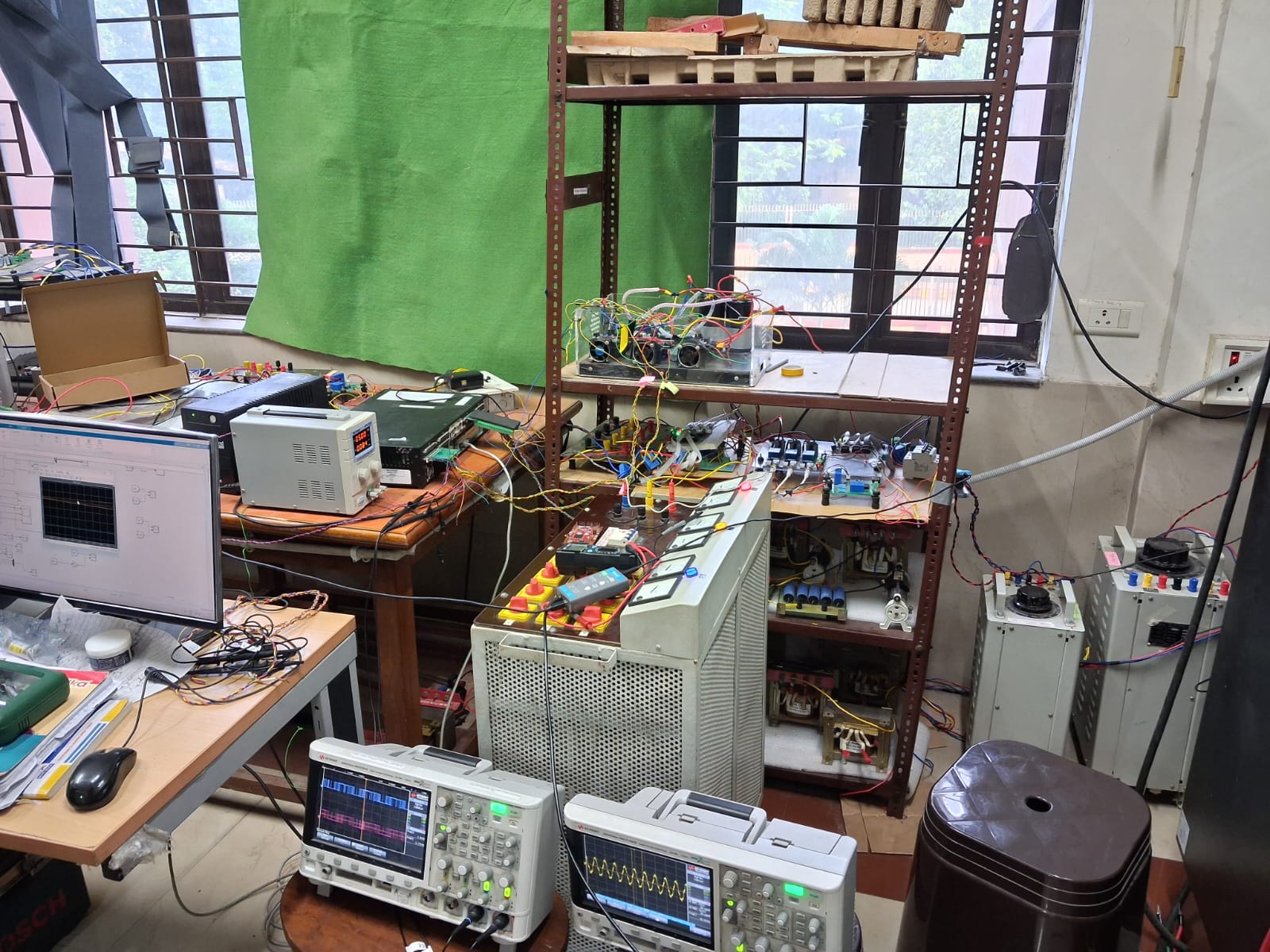
Hardware Prototype
VSC Based Active Power Filter & DSTATCOM
The voltage source converter (VSC) operates as an active power filter, primarily compensating for the harmonic currents generated by nonlinear loads connected at the point of common coupling (PCC). It also compensates for the reactive power demand of the load, thereby maintaining near-unity power factor at the grid side, hence working as Dstatcom
Research applications
Harmonic compensation, reactive power compensation, unity power factor control, DSTATCOM operation, nonlinear load filtering
Major equipment
VSC, Autotransformer, voltage and current sensor, opal rt, matlab simulink, linear and non linear load( 6 pulse diode bridge rectifier), DSO , current voltage probe , power quality analyzer, connecting wires, inductors , capacitors.
Research areas
Power Quality Enhancement of Grid-Connected Renewable Energy Systems
Principal investigator
Dr. V L Srinivas
Impact outcomes
1 Journal Published

Hardware Prototype
Axial Flux Induction Motor Drive
V/f Control of an Axial Flux Induction Motor Using a Speedgoat Real-Time Target Machine and TI TMS320F28379D
Research applications
Axial flux motor drive control, scalar V/f speed regulation, real-time target machine interfacing, encoder speed feedback
Major equipment
Axial Flux Induction Motor , DC TO AC converter, Encoder, sensors
Research areas
Drives application
Principal investigator
Dr. V L Srinivas
Impact outcomes
1 Conference Published

Hardware Prototype
Axial Flux PMSM Drive
V/f Control of an Axial Flux PMSM Using Speedgoat Real-Time Target Machine and TI TMS320F28379D
Research applications
Axial flux PMSM drive control, open/closed-loop speed control, real-time drive hardware-in-the-loop evaluation
Major equipment
Axial Flux PMSM , DC TO AC converter, Encoder, semsors
Research areas
Drives application
Principal investigator
Dr. V L Srinivas
Impact outcomes
1 Conference Published

Hardware Prototype
Programmable Grid Simulator
Grid Simulator for Emulating Balanced, Unbalanced, and Variable-Frequency Grid Conditions
Research applications
Grid fault ride-through emulation, frequency and voltage variation testing, microgrid grid-tied compliance testing
Major equipment
Grid Simulator, Converters, Sensors and Load
Research areas
Smart grid emulation, power electronics grid compliance, microgrid testing
Principal investigator
Dr. V L Srinivas
Impact outcomes
1 Technical Report Published

Hardware Prototype
TI C2000 DSP Prototyping
Generation of PWM signals, PWM with dead-band, sinusoidal PWM (SPWM) using sine–triangle comparison, phase-shifted PWM, and three-phase SPWM using the TI TMS320F28379D.
Research applications
Digital PWM generation, dead-band insertion, SPWM carrier control, phase-shifted PWM, 3-phase converter gate control
Major equipment
TI TMS320F28379D, DSOs
Research areas
Embedded DSP control in power electronics, pulse-width modulation algorithms, TI C2000 microcontrollers
Principal investigator
Dr. V L Srinivas
Impact outcomes
1 Technical Workshop Conducted
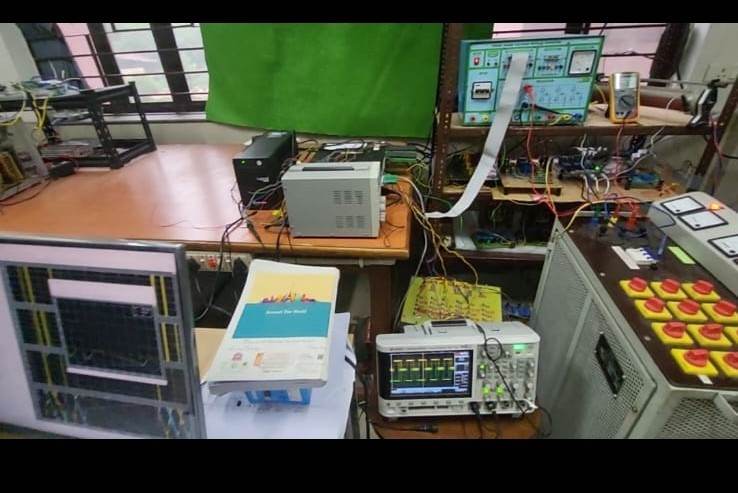
Hardware Prototype
Unified Power Quality Conditioner
Research facility for simulation, control, and experimental validation of UPQC systems for power-quality enhancement in electrical distribution networks
Research applications
Harmonic mitigation, voltage sag/swell compensation, reactive power compensation, load-current compensation, voltage/current unbalance mitigation, nonlinear-load compensation, renewable-energy integration, and advanced converter control
Major equipment
Series and shunt VSCs, DC-link capacitor, coupling transformers, interfacing filters, three-phase grid supply, nonlinear/unbalanced loads, measurement systems, PWM control systems, digital controllers, and MATLAB/Simulink and real-time simulation platforms
Research areas
Power electronics, power quality, UPQC, active power filtering, grid-connected converters, renewable-energy integration, adaptive control, MPC, real-time control, and smart grids.
Principal investigator
Dr. V L Srinivas
Impact outcomes
1 Journal Published

Simulation Framework
Anomaly Detection in EV SoC Fluctuations
A data-driven EVCI cybersecurity framework using ridge regression to predict changes in EV State of Charge (∆SoC) and detect and classify spoofing-induced anomalies.
Research applications
EVCI anomaly detection, SoC prediction, spoofing attack detection and classification, energy theft detection, charging behavior analysis
Major equipment
EVCI connected to utility grid with BESS, transformer, charging boards and charging ports; MATLAB and Python environments
Research areas
Electric vehicle charging infrastructure, cyber-physical power systems, machine learning, ridge regression, anomaly detection, spoofing attacks, EVCI cybersecurity
Principal investigator
Dr. V L Srinivas
Impact outcomes
1 Journal Published
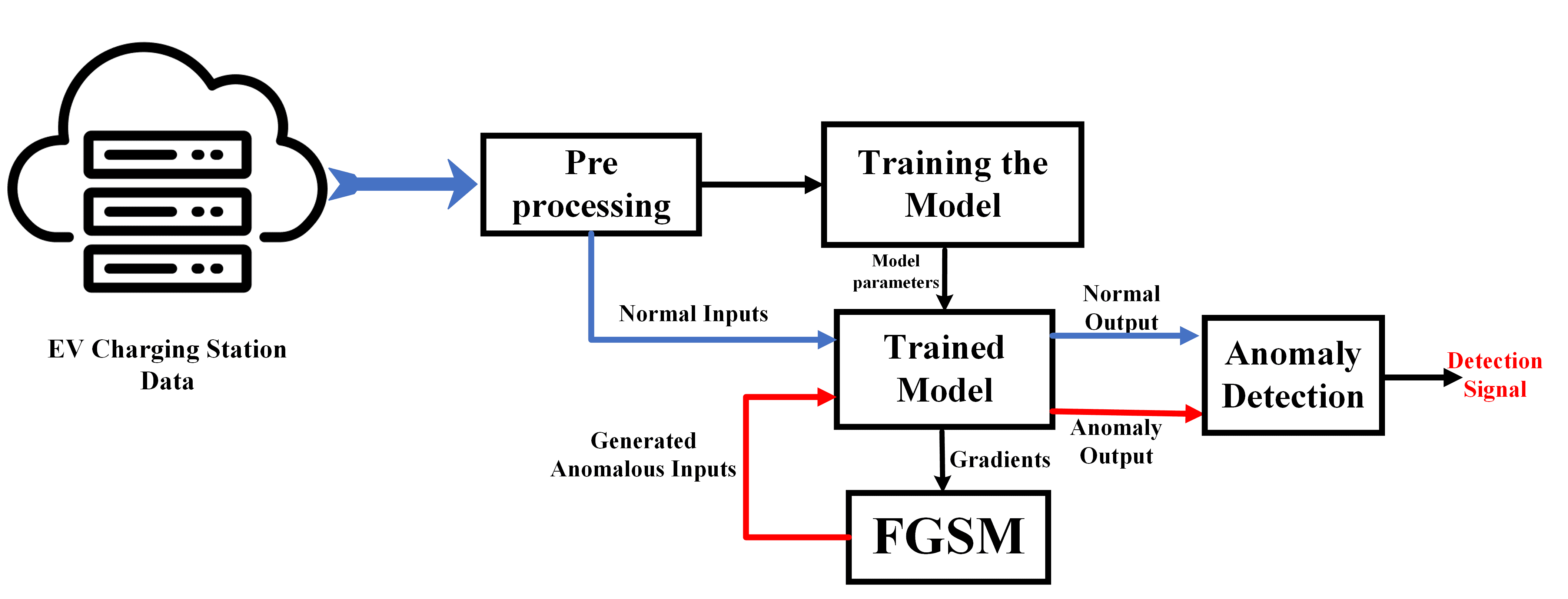
Simulation Framework
Cyber Attack detection on EV Charging Stations
An EVCI anomaly detection framework using an LSTM-based autoencoder to forecast charging-port current magnitudes and a KS-test-based method to identify adversarial anomalies generated using Fast Gradient Sign Method.
Research applications
Charging-port current anomaly detection, adversarial attack generation, spoofing detection, time-series forecasting, EVCI cybersecurity
Major equipment
MATLAB/SIMULINK-based EVCI model with AC-DC converter, BESS, four charging boards and eight charging ports; sequential charging-current data generation and processing
Research areas
Electric vehicle charging infrastructure, cyber-physical power systems, deep learning, LSTM autoencoders, FGSM adversarial attacks, time-series anomaly detection, cybersecurity
Principal investigator
Dr. V L Srinivas
Impact outcomes
1 Journal Published

Hardware Prototype
Attack-Resilient DC Microgrid
A cyber-resilient distributed DC microgrid control framework using a game-theoretic neural consensus (GTNC) controller to mitigate false data injection attacks while preserving voltage regulation, proportional power sharing, and consensus.
Research applications
FDIA-resilient DC microgrid control, neural attack mitigation, distributed consensus, voltage regulation, proportional power sharing, cyber-resilience, potential game-based control
Major equipment
Three-node ring-main DC microgrid with PV emulators, DC-DC converters, voltage/current sensing, resistive loads and real-time OPAL-RT controller
Research areas
ANN-based FDIA mitigation, DC microgrids, false data injection attacks, game theory, potential games, improved dynamic average consensus, distributed control, cyber-resilient control
Principal investigator
Dr. V L Srinivas
Impact outcomes
2 Journal Published
Facility records will appear here as the infrastructure archive grows.
RESEARCH IN ACTION
Experiments, prototypes and field work in motion.


WHO USES OUR FACILITIES?
Student research is shaped by the environments where ideas are tested.
Associated researchers and student activity will connect through the existing People profiles as facilities are documented.